
In modern industrial sectors such as food processing, textile printing and dyeing, photovoltaic module lamination, electronics manufacturing, and chemical conveying, PTFE (Polytetrafluoroethylene) conveyor belts (such as PTFE fiberglass conveyor belts and Teflon mesh belts) connect entire production lines due to their outstanding high-temperature resistance and anti-sticking properties. However, how to solve the Welding (welding) lifespan of PTFE conveyor belts under continuous high-temperature operation, and how to further enhance the extreme anti-sticking and permeation resistance of the belt surface, have always been core technical pain points in the industry.
As a smart manufacturing expert in high-performance fluoropolymer films, Fluoever New Material (Shanghai) Co., Ltd. (Fluoever) has launched the Fluoplus® FEP and PFA film series, tailored specifically for the PTFE conveyor belt industry by relying on advanced extrusion technology. Through precise optimization of welding and lamination processes, we assist global customers in building premium industrial conveying systems with longer lifespans and lower maintenance costs.
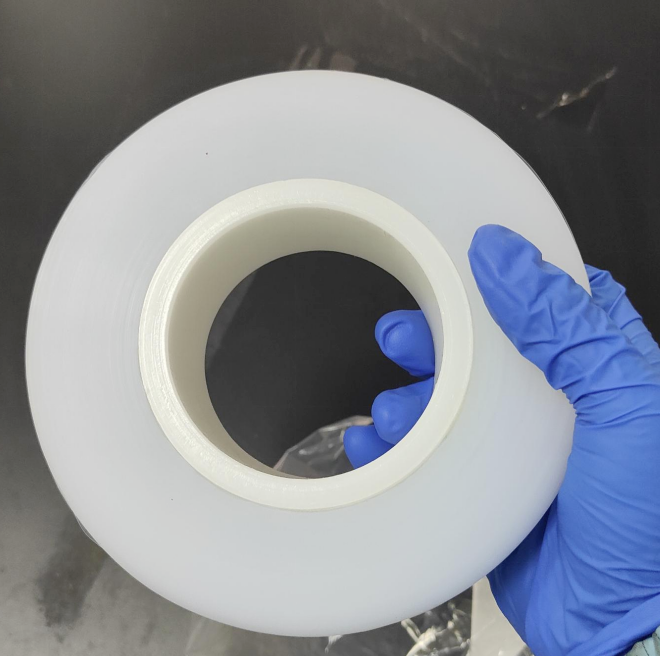
I. Why Do PTFE Conveyor Belts Need FEP and PFA Films?
PTFE (Polytetrafluoroethylene) itself is a non-meltable polymer, which means it cannot achieve self-adhesion or welding directly through traditional high-temperature thermal melting. When a PTFE conveyor belt requires a joint (butt joint/lap joint) during manufacturing or on-site installation, a thermoplastic fluoroplastic (FEP or PFA) with a slightly lower melting point and equally excellent heat and anti-sticking resistance must be utilized as the welding medium.
In addition, when dealing with the conveying of extremely viscous materials (such as PV cell lamination and high-sugar food baking), relying solely on the coating on the surface of the PTFE fiberglass fabric often leads to micropore permeation or localized wear. At this time, laminating a dense layer of high-barrier PFA/FEP film on the surface of the PTFE fabric can achieve true physical-grade “zero permeation” and extreme anti-sticking.
II. Core Applications of Fluoever FEP/PFA Films in PTFE Conveyor Belts
Fluoever accurately targets the actual scenarios of conveyor belt manufacturing, operation, and maintenance, focusing on the following two core application solutions:
High-Efficiency Conveyor Belt Joint Welding (Welding Film)
In the daily production and on-site joint sealing of PTFE mesh belts and Teflon conveyor belts, FEP and PFA films are widely used as welding rods/welding tapes.
- FEP Fim (Melting point approx. 260°C): Suitable for most conventional high-temperature conveyor belt joint welding, offering high cost-effectiveness and a wide processing window.
- PFA Film (Melting point approx. 305°C): Suitable for premium industrial belt joint Welding with higher operating temperatures (continuous operation above 260°C) and stricter requirements for flex fatigue life.
PTFE Fiberglass Fabric Surface Lamination (Physical Lamination)
For high-end special working conditions, Fluoever achieves online high-temperature lamination of high-performance PFA film with PTFE fiberglass fabric.
- Permeation Resistance & Ultra-Strong Anti-Sticking: The dense PFA film perfectly covers the weave texture of the fiberglass fabric, completely eliminating micropores. During food baking or polymer material lamination, it blocks the permeation of any glue, grease, or resin, maintaining an extremely low peel force.
- Extended Wear Life: With the help of PFA’s excellent flex fatigue resistance and high toughness, it significantly improves the wear resistance of PTFE conveyor belts during high-speed, repeated wrapping around rollers.
III. Thickness and Specification Range of Fluoever Products
To perfectly adapt to the requirements of different project loads, base fabric thicknesses, and high-tensile conveyor belts, Fluoever stocks an extremely rich range of core micron-level specifications year-round.
In terms of product specifications, the company’s commonly stocked general welding and lamination thicknesses cover 25mic (25μm), 50mic (50μm), 100mic (100μm), and 125mic (125μm). Among them, 25mic PFA film is widely used for surface lamination composites with PTFE fiberglass fabric due to its lightweight and high flexibility. Meanwhile, FEP/PFA films from 50mic to 125mic are precisely used as welding tapes for high-efficiency joint Welding or quick repair patches, depending on the light or heavy-duty load requirements of the conveyor belt. All specifications support ultra-wide master roll supply or precise narrow strip slitting according to engineering needs.
IV. Fluoever: Your Industrial Fluoroplastic film Customization Expert
As a professional manufacturer deeply rooted in the field of fluoropolymer materials, Fluoever New Material (Shanghai) Co., Ltd. always adheres to empowering modern manufacturing with excellent quality.
At our production base in Minhang, Shanghai, we adopt internationally leading precise extrusion and casting processes to strictly control the thickness tolerance of FEP/PFA films (ensuring uniform heating during welding without localized cold joints). In response to the conveyor belt industry’s special requirements for material width and length, we can not only provide ultra-wide master rolls for lamination up to 1600mm, but are also equipped with high-precision slitting lines to provide narrow strip-shaped joint Welding welding tapes a few centimeters wide. They are ready to use out of the box, significantly reducing on-site cutting waste for customers.
If you are looking for a stable raw material supplier that can improve the welding strength of PTFE conveyor belts or develop new PFA-laminated composite fabrics, please welcome to contact the technical expert team at Fluoever. We will provide you with a customized, comprehensive range of fluoroplastic film solutions.